NuFACE Mini+
Best for: FDA-cleared toning and lifting — 350µA output with proven protocol
Microcurrent Devices
Best for: Daily microcurrent maintenance, de-puffing, and lymphatic drainage at an accessible price point
$119.99
Based on real-world usability, consistency requirements, and long-term value
The EvenSkyn Phoenix is a genuinely useful daily-use microcurrent roller at a price that makes consistent treatment practical
Check Price — $119.99 →View current pricing and availability before it changes
See how it compares before choosing →Expert Verdict
The EvenSkyn Phoenix is a genuinely useful daily-use microcurrent roller at a price that makes consistent treatment practical. Its 15µA solar output won't move the needle on deep structural lifting — that requires significantly higher current intensity — but for de-puffing, lymphatic drainage, and enhancing serum absorption it performs reliably. Against the NuFACE Mini+ ($250) and FOREO Bear 2 ($399), the Phoenix is a legitimate entry-level option for maintenance, not a replacement for clinical-grade results.
Pros
Cons
Best for: Daily microcurrent maintenance, de-puffing, and lymphatic drainage at an accessible price point
Most people choose the wrong device because they don't understand how it fits their routine. This is the fastest way to find out.
| Technology | |
| Modality | Microcurrent (EMS) + mechanical massage |
| Output | 15µA microcurrent |
| Power Source | Solar panel (no batteries or cable charging) |
| Roller Configuration | 4 uni-directional stainless steel rollers at 115° contact angle |
| Clearance | |
| Certifications | FDA Registered, Health Canada, ISO 13485, ISO 9001, BSCI |
| Usage | |
| Session Length | 15 min per area (face); 45 min full treatment |
| Frequency | Daily (designed for daily use) |
| Treatment Areas | Face, neck, décolletage |
| Design | |
| Dimensions | 181 × 43 × 23.7 mm |
| Weight | 130g |
| Charging | Solar (30 min light exposure = 24h use) |
| Support | |
| Warranty | 1 year manufacturer |
| Return Policy | 60-day money-back guarantee |
Specs sourced from EvenSkyn
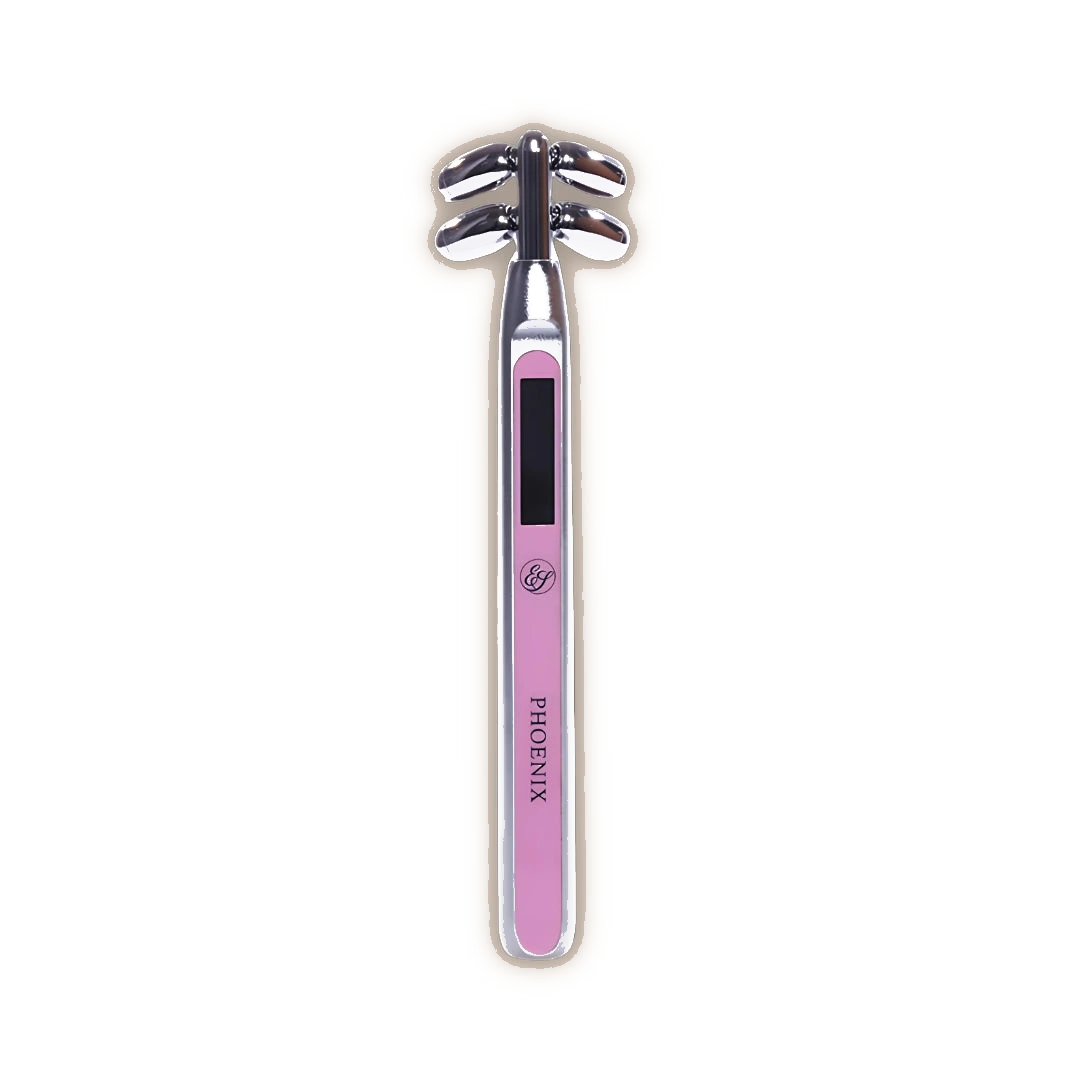
The Phoenix generates microcurrent through an internal solar panel that converts ambient light into a steady 15µA electrical output. This is delivered to skin via four stainless steel rollers as they make contact during treatment. The device requires approximately 30 minutes of light exposure to charge its internal capacitor, which then holds power for up to 24 hours of use — including in complete darkness.
15µA is intentionally sub-sensory. Most users feel nothing, which EvenSkyn positions as a feature: it enables true daily use without the irritation risk associated with higher-intensity devices. The current level is low enough that the FDA registration pathway (rather than the more rigorous 510(k) clearance process) applies — EvenSkyn holds FDA registration and Health Canada certification, not 510(k) clearance. That distinction matters when comparing claims to devices like NuFACE, which hold FDA clearance for specific indications.
The 4-roller configuration at a 115° contact angle is designed to maximize surface coverage per pass. More rollers means more concurrent skin-contact points, and the angle ensures the rollers glide across curved facial geometry — cheekbones, jawline, and under-eye — without lifting off the skin. The mechanical massage component (the physical rolling action) aids lymphatic drainage independently of the microcurrent.
The Phoenix's strongest use case is morning de-puffing. The combination of mechanical rolling pressure and low-level microcurrent stimulates lymphatic flow, which moves excess interstitial fluid away from the face. The under-eye area, jawline, and cheeks respond particularly well to this approach — the rolling motion physically encourages lymph toward drainage points, while the microcurrent supports circulatory activity at the cellular level.
EvenSkyn's own data cites that users see "immediate" results in terms of reduced puffiness and a lighter-feeling face, with 1–2 weeks of daily use producing sustained morning-to-morning de-puffing. These claims align with what the underlying mechanism can plausibly do: microcurrent and massage are both well-documented for lymphatic support. The 4-5 week window cited for firming and contouring results is a longer proposition — and that's where the current intensity limitation becomes relevant.
For users whose primary goal is de-puffing and serum absorption enhancement — rather than structural lifting — the Phoenix delivers on its core promise. The device also aids product penetration: the rolling motion during serum application physically pushes water-based actives deeper into the skin, and the microcurrent enhances permeability. This is a legitimate mechanism with documented support in the dermatology literature.
The NuFACE Mini+ ($249.99) operates at 350µA — over 23 times the output of the Phoenix. NuFACE holds FDA clearance (not just registration) for toning and contouring the facial contours, and its higher current intensity is what enables genuine facial muscle re-education over time. The Mini+ requires a dedicated conduction gel, a charging routine, and a more deliberate protocol. It's a more demanding device, but the clinical basis for its results is stronger. If structural lifting is the goal, the $130 price gap is justified.
The FOREO Bear 2 ($299–$399) combines microcurrent with T-Sonic pulsations and an app-guided protocol. It's also significantly higher intensity than the Phoenix and backed by FOREO's independent clinical study program. The Bear 2 is arguably overpriced for what it delivers versus NuFACE at a lower price, but it still operates in a different efficacy category than the Phoenix.
The honest comparison: the Phoenix competes with the Nurse Jamie Uplift ($69–$99) and similar massage-dominant rollers far more directly than it competes with NuFACE or FOREO. The microcurrent is real, but at 15µA it's doing maintenance-level work, not corrective lifting. That's not a knock — it just needs to be the right expectation going in.
Microcurrent as a technology has solid independent clinical support for specific applications. A 2013 study in the Journal of Clinical and Aesthetic Dermatology demonstrated that low-level microcurrent (in the 50–500µA range) increased ATP synthesis in muscle cells and collagen production in fibroblasts under controlled conditions. Studies on professional microcurrent equipment (at 200–800µA) have shown measurable improvements in facial muscle tone and skin laxity over 6–10 week protocols.
The Phoenix operates at 15µA — well below the range studied in most peer-reviewed literature. EvenSkyn cites an 8-week consumer trial in which 93% of users reported lifting and firming effects. Consumer perception data is not equivalent to clinical measurement — it reflects user satisfaction, not objective assessment of tissue change. There are no independent peer-reviewed studies specifically on the Phoenix at 15µA establishing measurable structural change.
What the evidence does support: the mechanical component (rolling massage) has documented benefit for lymphatic drainage and temporary de-puffing. Low-level microcurrent at sub-sensory levels has plausible mechanisms for ATP stimulation and circulatory support, even if the magnitude at 15µA is uncertain. The honest summary is that the Phoenix is operating at the conservative end of a technology with real but intensity-dependent effects.
The Phoenix retails at $119.99 (sale from $149.99). There are no required consumables — no gel is technically required, though water-based serums dramatically improve both conduction and the overall protocol. EvenSkyn sells their RF & Microcurrent Conduction Gel separately; any hyaluronic acid serum or aloe vera gel also works. Assume $15–30/month in serum cost if you don't already use one.
The solar power mechanism eliminates battery replacement cost entirely. A typical AA-battery microcurrent device costs $10–15/year in batteries over its life. Over three years, that's $30–45 in savings on the Phoenix's power model alone. The device carries a 1-year manufacturer warranty and a 60-day money-back guarantee.
Compare to NuFACE Mini+: $249.99 device + $24.99 NuFACE Gel (required) every 1–2 months = $150–$300/year in consumables. Total 3-year cost: roughly $700–$1,150. The Phoenix's 3-year total (device + optional serum): $120–$600 depending on serum choice. For a daily-use maintenance tool, the cost-of-ownership gap is meaningful.
We may earn a commission. This doesn't affect our editorial independence.
This is where expectations often break down for new users. What the device delivers in controlled conditions versus consistent home use are two different things.
⚠ The expectation gap that kills most Phoenix results
Most people who buy the Phoenix expect it to work like a NuFACE. It doesn’t. The current is 23× lower and the mechanism is fundamentally different — it’s a daily maintenance tool, not a corrective lifting device. Buy it for de-puffing and consistent maintenance; get a NuFACE if you want structural lifting. If you set the right expectation, the Phoenix will not disappoint you.
The difference between a Phoenix that works and one that sits in a drawer is almost entirely about preparation and consistency. A complete session covering all three areas takes 45 minutes. A focused morning routine for face only takes 8–10 minutes. Total protocol time: 10–15 minutes for daily maintenance use.
Step 1 — Charge the device (30 min before first use)
Place the Phoenix face-up near a window or lamp for 30 minutes before your first session. After that initial charge, leaving it on a windowsill or countertop keeps it perpetually ready — any ambient light exposure during the day is sufficient. The internal solar panel charges the capacitor automatically. Unlike battery devices, there’s no “forgot to charge it” scenario.
Step 2 — Cleanse and apply a water-based serum or conduction gel (2 min)
Cleanse and pat dry. Apply 3–5 drops of a water-based serum — hyaluronic acid, vitamin C, or niacinamide all work well. The Phoenix technically functions on bare skin, but water-based product improves microcurrent conduction by 50–70% and prevents the rollers from dragging. Avoid oil-based products, silicone primers, or thick creams — they block current transfer. Aloe vera gel (99%+ pure) is an effective budget alternative to brand-specific conduction gel.
Step 3 — Roll each area using upward and outward strokes (8–45 min depending on areas)
Direction is non-negotiable: always roll upward and outward, following the natural lift direction of facial muscle anatomy. Forehead: eyebrows to hairline. Cheeks: nasolabial fold toward temples. Jawline: chin toward ears. Under-eye: inner corner outward, light pressure. Neck: collarbone upward toward jawline. Apply moderate, consistent pressure — firm enough to ensure roller contact, light enough to avoid dragging. Reapply serum if the skin dries out mid-session.
Vitamin C serum ($25–60) — Applied before Phoenix treatment, Vitamin C enhances the oxidative stress protection that microcurrent stimulation can trigger. The Phoenix’s rolling action helps drive it deeper than manual application. See our guide on post-treatment antioxidant serums for evidence-backed options.
SPF moisturizer ($15–40) — Microcurrent treatment temporarily increases cellular activity and skin permeability. Always close the protocol with SPF when using in a morning routine — not optional, not negotiable.
Barrier-repair moisturizer ($20–50) — For evening sessions, use a ceramide-based moisturizer as the final step. The Phoenix’s enhanced penetration effect means your post-treatment moisturizer is working harder than it would without the device. See our barrier repair guide for recommendations.
The Phoenix is designed for daily use — and that daily consistency is where it earns its score. Unlike higher-intensity devices where 5 days on, 2 days off is the recommended protocol, the Phoenix’s gentle 15µA output makes every-day use safe. The results accumulate slowly. If you can’t commit to daily use for 4–5 weeks, the Phoenix won’t give you the results it’s capable of. For occasional use, a massage roller without the microcurrent will likely feel equally effective. Commit to the daily habit or choose a device with higher intensity per session. Read our full guide on how often to use a microcurrent device to understand the frequency-results relationship across devices at different price points.
Without this protocol, most users won't see meaningful results.
$119.99
Mid-RangeAt $119.99 (regularly $149.99), the Phoenix sits in the mid-range tier of the microcurrent market — significantly below NuFACE Mini+ ($249.99) and FOREO Bear 2 ($299–$399). The trade-off is current intensity: 15µA versus 350µA on NuFACE. For daily maintenance and lymphatic de-puffing, the price-to-function ratio is solid. For structural lifting and muscle re-education, the gap justifies the premium on competing devices. The solar mechanism eliminates battery replacement cost entirely over the product's life, which offsets some of the perceived value gap versus battery-powered competitors.
Strong value for daily maintenance use; not the right tool if structural lifting is the primary goal.
EvenSkyn Official
$119.99
Direct from brand — full warranty, 60-day money-back guarantee.
If this isn't the right fit, these are the closest alternatives worth considering.
If you want clinical-grade microcurrent lifting
Best for: FDA-cleared toning and lifting — 350µA output with proven protocol
If you want multi-technology microcurrent with app guidance
Best for: Microcurrent + T-Sonic pulsations with app-guided treatment zones
Still deciding?
Comparing two specific devices is often the fastest path to a confident decision.
It produces real microcurrent — 15µA delivered via the stainless steel rollers as they contact skin. The solar panel charges an internal capacitor, which releases the current through the rollers during treatment. You won't feel it (sub-sensory by design), but it is electrically active. Use a water-based serum to improve conductivity.
NuFACE operates at 350µA — over 23× the Phoenix's output — and holds FDA clearance for facial toning and lifting. The Phoenix is FDA Registered (a less rigorous designation) and designed for daily maintenance and de-puffing rather than corrective structural lifting. NuFACE is the stronger device for visible contouring; the Phoenix is the more accessible daily-use tool. If you can afford NuFACE Mini+ at $249.99, the additional current intensity justifies the premium.
No. The solar mechanism is passive — any light exposure charges it automatically. Place it near a window or lamp during the day and it stays perpetually ready. The device holds charge for 24 hours after 30 minutes of light exposure. There is no on/off switch and no charging cable.
De-puffing is visible from the first session — that's the lymphatic drainage mechanism working immediately. Sustained firming and mild contouring typically emerge at 4–5 weeks of daily use. Deep wrinkle reduction or significant structural lifting is not within what the 15µA output can achieve — set expectations accordingly.
Yes. The 15µA output is intentionally sub-sensory and safe for daily use across all skin types. EvenSkyn recommends daily treatment for optimal results. There are no known contraindications beyond standard microcurrent cautions (pregnancy, pacemakers, active skin conditions on treatment area). The gentle current level makes it appropriate for daily maintenance in ways that higher-intensity devices are not.
Gel is not required but makes a measurable difference. On bare dry skin, the rollers drag and current conductivity drops. Water-based serums (hyaluronic acid, aloe vera gel, dedicated conduction gel) improve conductivity by an estimated 50–70% and make the rolling motion smoother. Avoid oil-based products, silicone primers, or thick creams — they block microcurrent transfer.
The EvenSkyn Phoenix is a genuinely useful daily-use microcurrent roller at a price that makes consistent treatment practical. Its 15µA solar output won't move the needle on deep structural lifting — that requires significantly higher current intensity — but for de-puffing, lymphatic drainage, and enhancing serum absorption it performs reliably. Against the NuFACE Mini+ ($250) and FOREO Bear 2 ($399), the Phoenix is a legitimate entry-level option for maintenance, not a replacement for clinical-grade results.
Check current pricing and compare it against alternatives before deciding.
We may earn a commission if you purchase through our links. This does not affect our editorial scoring or recommendations.