A Celliara guide to red light therapy devices
Red Light and Sleep: What the Research Shows and What It Doesn’t
Light, Melatonin and the Circadian System
Your body uses light as its primary circadian signal. Blue light (400–490nm) suppresses melatonin production by activating melanopsin-containing retinal cells — which is why bright evening screens and overhead lighting come up so often in sleep research. Red light has been studied as a contrast.
Red light interacts less with melanopsin-containing cells than blue light. In a small 2025 study by Sanchez-Cano and colleagues (Life), 12 adults sat under red (631 nm) or blue (464 nm) LED light at the same brightness (80 lux at the eye) from 9 p.m. to midnight: melatonin fell under both colours in the first hour, then recovered under red light but stayed suppressed under blue. That is a comparison of two light colours under study conditions; it does not show that a consumer red light device is circadian-safe or cannot affect melatonin.
A separate proposed mechanism involves cellular energy (cytochrome c oxidase); laboratory research on it does not establish any effect on sleep.
The key distinction: red light does not produce melatonin, and research suggests it suppresses melatonin less than short-wavelength light. Whether it has any direct effect on sleep quality is not established by the studies Celliara verified for this guide.
What the Research Actually Shows
A 2012 study by Zhao and colleagues (Journal of Athletic Training; PMC3499892) gave 10 female basketball players whole-body red light averaging 658 nm (30 J/cm²) for 30 minutes every night for 14 days, while 10 placebo participants lay under the device without light; the red-light group showed better sleep-quality scores (Pittsburgh Sleep Quality Index) and serum melatonin levels than the placebo group. The study used those athletes, that whole-body setup and that schedule; it does not tell you what a consumer panel or lamp will do for your sleep.
The honest summary: the two studies described here are small (20 and 12 participants) and short, and Celliara has not verified whether their findings have been replicated. The evidence Celliara verified does not establish that red or near-infrared light improves sleep for people in general, that evening use is circadian-safe, or that a consumer device reproduces any study’s setup.
Wavelengths Used in the Research
Studies and devices use different wavelengths. What each band is, and what the sleep research does and doesn’t cover:
- 630nm: Visible red, used on many skin-focused panels.
- 660nm: A red wavelength common on consumer panels. The basketball-player study used light averaging 658 nm; one study’s wavelength does not make it a requirement for a sleep device.
- 670nm: Close to 660nm.
- 810–850nm: Near-infrared (NIR). Not visible to the eye, so it is not the visible-light signal the melatonin research compares; Celliara has not verified sleep evidence for near-infrared light.
- 900nm+: Deep NIR. Celliara has not verified sleep-specific evidence at these wavelengths.
Device Types and What They Are For
Red light products differ in output and purpose. None in Celliara’s record is shown to treat sleep.
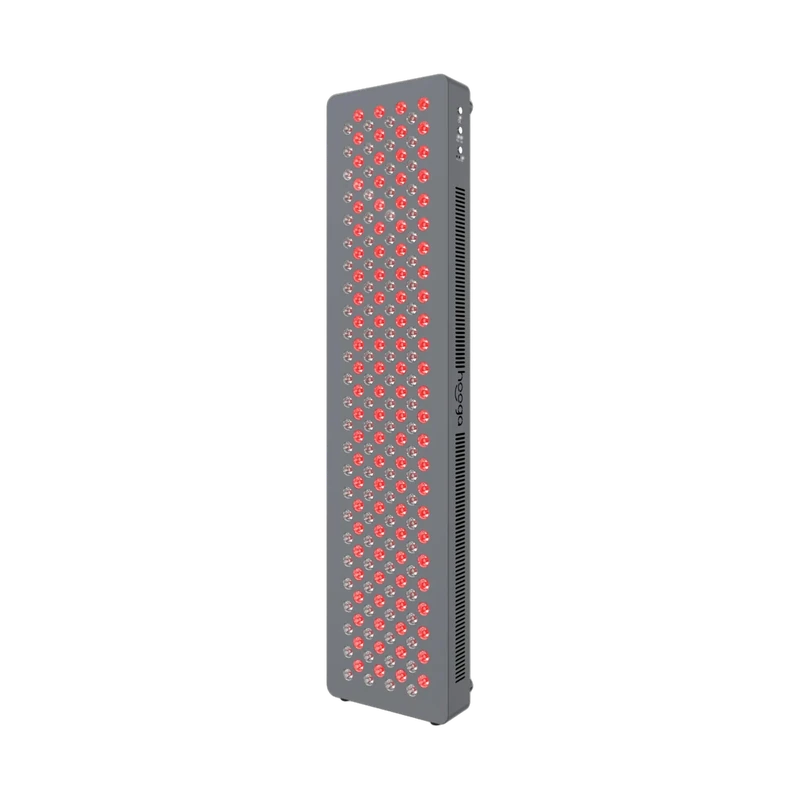
Full-body panels: Large panels such as the Hooga HG1000 treat the torso or back in one position; see our Hooga HG1000 review for its specifications and Hooga’s own session guidance. Celliara’s record does not establish that any panel improves sleep.
Targeted panels (mid-size): Cover the torso or face and upper body; smaller and more affordable than full-body panels.
Dedicated red lamps: Lower-power lights sold for evening use. They emit red rather than blue light, but Celliara’s record does not establish their effect on sleep.
Wearables and wraps: Targeted NIR/red light devices worn on specific body areas. Designed for localized use rather than sleep.
The panel named in this guide
Current facts and scores come from each device’s Celliara review.
What Specifications Can and Can’t Tell You
If you are considering a red light product for evening use, these specifications describe the device; none of them establishes a sleep benefit:
- Wavelength output: Check the stated wavelengths on the spec sheet, not just marketing copy.
- Irradiance at distance: A figure in mW/cm² measured at a stated distance lets you compare devices. It is not a threshold for sleep, and the maker’s own distance and session guidance applies.
- Flicker: Some makers state flicker-free or high-frequency dimming; check the specification if it matters to you.
- EMF output: Some makers publish EMF data.
- No blue light emission: Obvious but worth confirming. Some multi-purpose LED panels include blue wavelengths — verify the spectrum before evening use.
- Timer controls: Many panels have built-in timers; follow the maker’s session limits.
What the Studies Used, and Why It Isn’t a Routine
Sleep studies used specific setups: the basketball-player study used 30-minute whole-body sessions each night for 14 days. Those are study conditions, not a schedule for you, and Celliara does not set a time before bed, a session length, a distance or a frequency.
Eye safety: Follow the exact device’s eye-protection instructions; near-infrared light is invisible, so you cannot judge exposure by how bright it looks.
Realistic Expectations
Red light therapy is not a sleep medication. The research does not establish that a consumer device will improve your sleep.
If you have a sleep disorder such as insomnia, sleep apnea or a circadian rhythm disorder, talk to your doctor; red light products are not a treatment for it.
Safety Considerations
Each manufacturer sets who should not use its device, so read the exact device’s current warnings before you buy or use one. Where a manufacturer says not to use its device, a clinician’s advice does not change that. A few points to check:
- Light-sensitising medications: If you take a medication that increases light sensitivity, check the device’s warnings and ask your prescriber or pharmacist.
- Active skin conditions: If you have active rosacea, lupus, or other photosensitive skin conditions, consult a dermatologist before starting RLT sessions.
- Intensity in small spaces: Using a high-irradiance panel in a small bedroom can cause temporary warmth. Follow the maker’s guidance on placement and room use.
- Children: Celliara’s current evidence record does not establish safe-use guidance for infants or young children.
Frequently Asked Questions
Does red light therapy increase melatonin?
Not directly. In the 2025 study described above, melatonin fell under both red and blue light in the first hour, then recovered under red light but not under blue. That does not show a consumer device is circadian-safe.
Can I use a red light panel right before bed?
Celliara’s record does not establish a safe or effective time before bed. Follow the device maker’s instructions.
What’s the difference between red light therapy and red ambient lighting?
Panels are designed to deliver far more light than a red bulb or lamp. Neither is established as a sleep treatment.
How long until I notice sleep improvements?
The basketball-player study measured changes after 14 nights. That does not predict what you will notice, and Celliara’s record does not establish a timeline for consumer devices.
Is near-infrared (NIR) or red light better for sleep?
The basketball-player study used red light averaging 658 nm; Celliara has not verified sleep evidence for near-infrared light. Celliara’s record does not establish that either is better for sleep.
Do I need a prescription or doctor approval?
No prescription is needed for consumer red light devices. If you have a sleep disorder, a light-sensitive skin condition or take medication that increases light sensitivity, talk to your healthcare provider and check the device’s warnings.
Where to go next
See current recommendations
Our ranked page names the devices we recommend and who each one suits.
- Best Overall MitoMIN 2.0
- Best for Face + Upper Body MitoMID 2.0
- Best Full-Size Panel Hooga HG1000
- Best for Largest Coverage MitoMEGA 2.0
Explore the category
What separates the devices Celliara has reviewed, with every review in one place.
Red light therapy panels